Home service businesses operate in a market where speed, visibility, and customer trust all decide who gets the job. Owners are juggling marketing budgets, lead channels, and customer communication at the same time, often with limited help and limited time.
To understand how home service businesses actually approach marketing, lead generation, and customer communication in 2026, we surveyed 400 owners and operators across the U.S.
About this study
This survey was conducted in May 2026 through Pollfish, an independent research platform.
All 400 respondents were screened to confirm they own, operate, or help run a home service business in the United States, spanning verticals such as HVAC, plumbing, electrical, roofing, cleaning, and pest control.
Key takeaways
- 64% of home service businesses say the owner is primarily responsible for marketing.
- 61% allocate at least 4% of annual revenue to marketing.
- Generating high-quality leads is the single biggest challenge, named by 29% of owners.
- 44% respond to new inquiries within 15 minutes during business hours.
- 57% believe they've lost jobs because they missed a call or responded too slowly.
- Only 40% have an automated reply that catches after-hours inquiries.
- Just 22% capture inquiries through a website texting widget, even though 83% offer SMS in some form.
Marketing investment is strong across home services
Home service businesses aren't winging it. Most are putting real money behind marketing and watching where it goes.
In our survey, 61% allocate at least 4% of annual revenue to marketing, and 46% put in 8% or more. That's a meaningful commitment for businesses that often run lean, and it signals owners who see marketing as a growth lever rather than an afterthought.
The discipline goes beyond spend. 84% track what it costs them to acquire a lead at least occasionally, and 82% track return on investment for some or every channel.
Most home service businesses still run marketing themselves
For all that investment, marketing in home services is overwhelmingly a one-person job. 64% of owners say they're primarily responsible for it, while only 13% have a dedicated in-house marketer or team.
This matters more than it first appears. The owner setting the budget and choosing the channels is usually the same person answering the phone, quoting the job, and calling people back. Marketing, sales, and operations all run through one set of hands.
That arrangement keeps costs down and decisions fast. It also means the system is only as available as the owner is. When they're under a sink or on a roof, the marketing engine and the response engine both pause.
Owners say their biggest challenge is lead quality
When we asked owners to name their single biggest marketing challenge, the answers clustered at the top of the funnel. 29% pointed to generating high-quality leads rather than just volume.
Another 18% named converting leads into booked jobs, and 15% said generating enough leads at all.
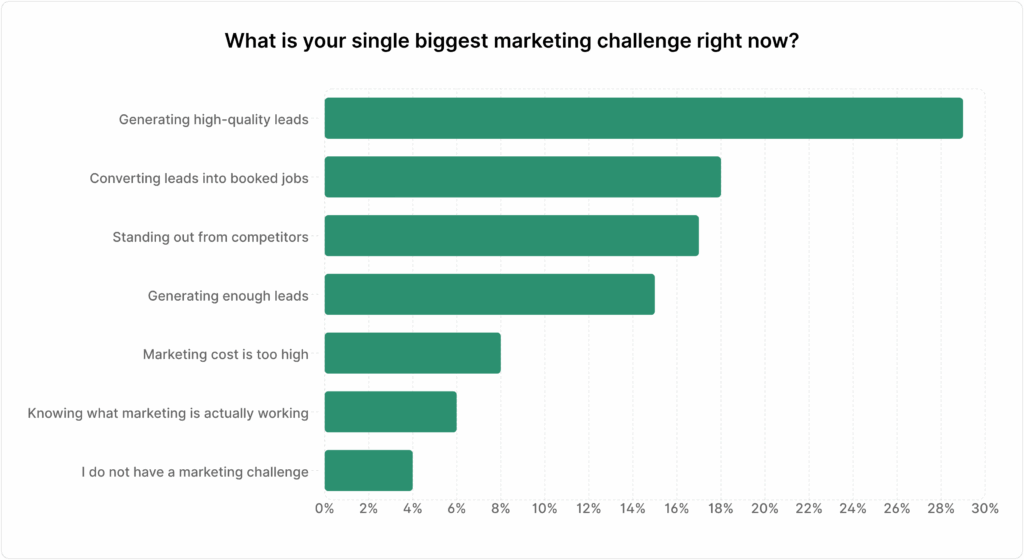
Almost nobody flagged how quickly or consistently they respond to inquiries. In owners' minds, the problem is getting the right people to reach out, not what happens once they do.
That's a reasonable instinct, and it's worth taking seriously. But it also sets up a gap.
Owners are focused on filling the top of the funnel, while the data points to a leak further down that very few of them are naming.
Most businesses respond fast, at least during business hours
Here's the part home service businesses get right. Response times during business hours are genuinely quick.
16% of owners say they respond to a new inquiry within 5 minutes, 27% within 15 minutes, and 26% within 30.
Put together, roughly 70% are responding inside half an hour.
If response speed were the whole story, home services would look like a solved problem.
Owners feel fast, and on a normal weekday afternoon, they are. The trouble is that the average hides what happens on the edges.
Stop losing jobs to slow responses
TextNinja turns website visitors into text conversations so your team can respond faster and win more work.
Start free trial
Most owners believe they've lost jobs to slow responses
Despite those fast response times, the same owners report a steady drip of lost work.
57% believe they've lost a job because they missed a call or responded too slowly. 19% say it happens regularly, and 37% say it's happened a few times that they know of.
Another 25% suspect it has happened but can't confirm it, which means only about one in six owners is confident it has never happened to them.
After-hours coverage depends on people, not systems
The first crack shows up after the workday ends. We asked owners what typically happens when a customer reaches out after hours or on a weekend.
40% said a team member responds in real time anyway. 40% have an automated text or message that acknowledges the inquiry and sets up a next-day follow-up.
The remaining 12% wait until the next business day with no acknowledgment at all, and a small share aren't sure or respond inconsistently.
Missed calls still get handled by hand
The second crack is the missed call, and it's handled much the same way: manually.
When a call gets missed, 54% of businesses call the customer back by hand. 29% send an automated text message, and 11% say they follow up but not consistently. A small remainder often don't follow up at all.
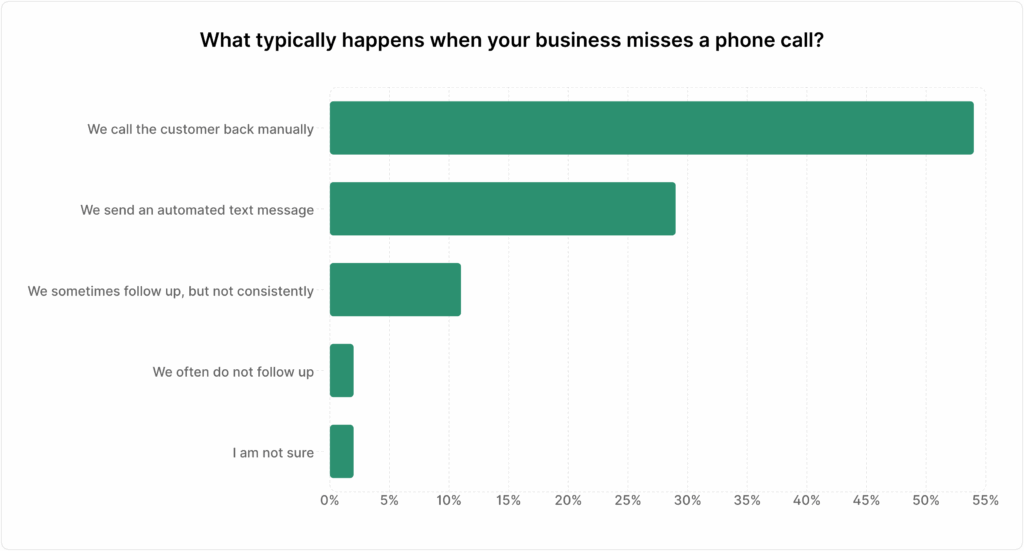
Manual callback works right up until it doesn't. It depends on someone noticing the missed call, remembering to return it, and getting to it before the customer has moved on.
That chain breaks during exactly the busy stretches when calls get missed in the first place, and those are the same moments a homeowner with a burst pipe is dialing the next business on their list.
An automated text that fires the instant a call is missed keeps the conversation alive without anyone having to remember anything.
Texting is everywhere except where it matters most
There's a channel that fixes a lot of this, and home service businesses already use it, just not where it counts.
When we asked how customers currently reach these businesses, the top channels were phone calls (65%), email (58%), and website contact forms (49%).
The website texting widget came in near the bottom at 22%. Yet 83% of businesses offer SMS in some form, whether prominently advertised or quietly available.
So texting is available almost everywhere, but it's rarely positioned at the website, the exact moment a high-intent visitor is deciding whether to reach out or click away.
Those visitors are landing on contact forms and phone numbers, the slower and higher-friction options, while the fast, familiar channel most of these businesses already support sits unused at the point of decision.
Stop losing jobs to slow responses
TextNinja turns website visitors into text conversations so your team can respond faster and win more work.
Start free trial
Most owners plan to spend more on the same channels
Looking ahead, owners are doubling down on acquisition.
More than 60% plan to increase investment in Google, paid search, or social over the next year, with Google Local Services and Google Ads (22%), Facebook or Instagram (21%), and organic Google Search (19%) leading the list.
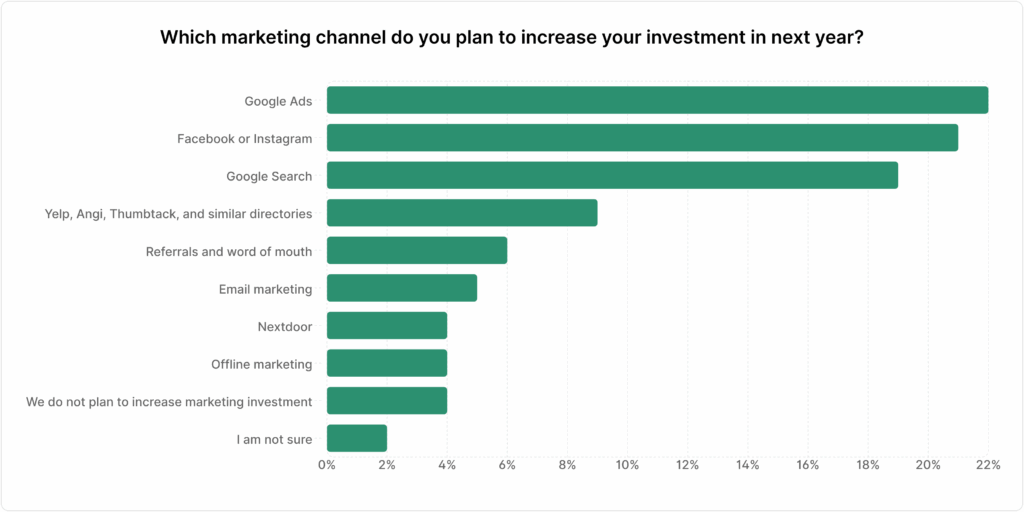
There's nothing wrong with buying more traffic. But it's worth asking what happens to those new leads when they arrive. If the response system already leaks after hours, on missed calls, and at the website, then more spend simply pushes more leads into the same cracks.
The higher-leverage move for many businesses is making sure the leads they already pay for get a fast, reliable response every time, so more of them turn into booked jobs instead of slipping away to a competitor who replied first.
Rethinking marketing performance in home services
The takeaway from this data isn't that home service businesses need to respond faster. Most already respond quickly when they're at their desks and the day is calm.
It's that the definition of marketing performance needs to shift from speed to reliability. A 10-minute average response time doesn't help the customer who called during a job, reached out at 9 p.m., or got missed during a rush.
What separates the businesses that win those jobs isn't how fast they can reply on a good day. It's whether the first interaction is handled consistently every time, including the moments when the owner isn't free to handle it personally.
How TextNinja can help
TextNinja is a web-to-text platform built for home service businesses that want to capture more website visitors and respond to every inquiry quickly and consistently.
It turns website visitors into text conversations through a simple widget, so high-intent visitors can reach out in the channel they already prefer instead of filling out a form.
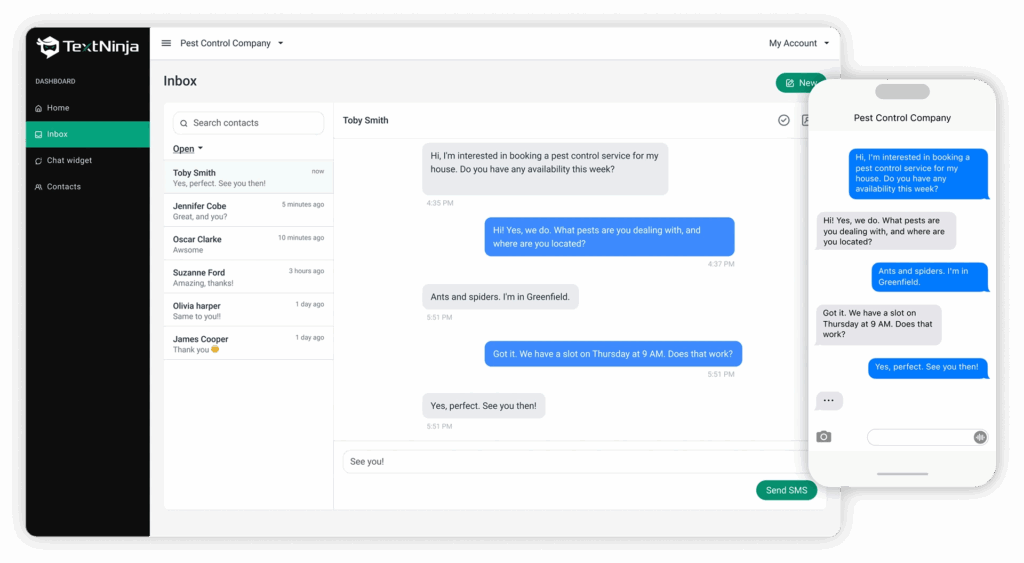
Automated and templated replies mean fast first responses don't depend on someone being free to send them, and they keep working after hours and when calls get missed.
A shared inbox brings every conversation into one place so nothing slips through the cracks, and built-in analytics show how quickly your team is actually responding.