
Marketing an electrical business is different from marketing most other services.
Customers usually find you in a moment of stress, comparing options quickly, and often calling more than one company before deciding.
We asked digital marketing agencies that work with electricians and operators inside the trade to share what electrician marketing tactics they've seen consistently move the needle.
Here's what they shared.
1. Optimize your Google Business Profile
When someone's panel trips or a breaker keeps flipping, they're typing "electrician near me" and calling whoever shows up first in the map pack.
They want fast help, and the businesses at the top of local search results are the ones getting those calls.
That makes your Google Business Profile (GBP) one of the highest-leverage assets you have.
Here, the basics matter more than most operators realize. Accurate categories, a clear service area, recent photos of real jobs, and a steady stream of fresh reviews are what push you into the top three local results.
Updating your profile weekly and replying to every review keeps the signal strong over time.
Mike Khorev, SEO and AI Visibility Consultant, shared:
"The method which works best for electricians involves combining local search engine optimization with optimizing their Google Business Profile.
Most customers searching with high intent (e.g. 'emergency electrician near me') will result in immediate calls and having visibility in the local pack will increase numbers of inbound leads significantly.
We have proven this by seeing electricians double the number of leads by improving category settings, adding real job photos and collecting genuine reviews.”
2. Run Google Local Service Ads
Local Service Ads (LSAs) sit at the very top of Google search results, above regular Google Ads and organic listings.
They show your business name, rating, and the Google Guaranteed badge, which is a trust signal no other ad format offers.
The pricing model is what makes LSAs especially effective for electricians. You pay per lead, not per click, so you're only spending money when a real prospect contacts you through the ad.
Lead costs typically run lower than what you'd spend chasing clicks on standard Google Ads, and the leads tend to convert better because the badge pre-qualifies trust.
The catch is responsiveness. Google tracks how fast you reply, and slow response times push you down the rankings.
Here's what Rhillane Ayoub, CEO of Rhillane Marketing Digital, had to say:
"We set this up for a client who does residential and commercial electrical work.
Before LSAs, they were spending $2,800/month on Google Ads generating about 35 leads.
After adding LSAs, cost per lead dropped from $80 to $40, and the LSA leads had a higher close rate because the Google Guaranteed badge pre-qualified trust."
3. Use call-focused Google Ads
Standard Google Ads campaigns often send traffic to a contact form. For electricians, that's a poor fit.
Homeowners with a sparking outlet or no power don't want to fill out a form and wait. They want to call someone now.
Setting up your campaigns to prioritize phone calls instead of form fills can dramatically lift conversion rates. Use call extensions, call-only ads, and landing pages that put the phone number front and center.
Pair that with a clear promise about response time, like answering within 60 seconds, and you give homeowners a concrete reason to choose you over the next listing.
Christopher Coussons, Director at Visionary Marketing, explains:
"We committed in the ad copy and on the landing page to 'call answered in 60 seconds or $65 off the job.'
That single line lifted click-through from 4.1% to 7.8%, and lead-to-booking conversion from 18% to 31%.
The $65 promise cost the business about $260 a month in redemptions. It brought in roughly $8,500 a month in new work."
4. Create location-specific service pages
A single "electrical services" page that tries to rank for everything ends up ranking for nothing. The electricians who consistently win organic search build dedicated pages around specific services in specific locations.
Think pages like "panel upgrades in Plano" or "EV charger installation in Frisco" instead of one generic services page.
Each page should include real local context: the typical permit process, common housing stock issues in the area, ballpark cost ranges, and photos from nearby jobs.
That depth tells Google the page genuinely serves the searcher, not just an SEO checklist.
Avoid templated copy with the city name swapped in. Google sees through that, and so do homeowners.
Josiah Roche, Fractional CMO at JRR Marketing, shared his experience:
"One tactic that's worked best is building suburb-by-suburb 'service + problem' pages, then backing them with a proper Google Business Profile and local citations.
For example: 'Electrician in Newtown - power trips and switchboard upgrades' instead of one generic 'Electrician Sydney' page.
On one metro electrical business, this approach took them from about 8 to 25 suburb pages over three months, and organic enquiries went up roughly 35% while their Google Business Profile calls rose about 20% over the next 8-10 weeks.”
5. Target homeowners who tried to DIY first
A lot of homeowners try to fix small electrical issues themselves before calling a professional. When the DIY attempt fails, they search again, this time with very different intent
Phrases like "light switch sparking after replacement" or "ceiling fan not working after install" signal someone who's already invested time, gotten in over their head, and is ready to pay for help.
Building content around those moments puts you in front of motivated, less price-sensitive prospects at exactly the right time.
The most effective version uses plain safety language, explains likely causes, and tells the homeowner what to do next. That makes your business feel credible and immediately relevant.
Pearly Chan, SEO Manager at One Search Pro, says:
"Content built around phrases like light switch sparking after replacement or ceiling fan not working after installation reaches people who already tried to fix the issue and now want a professional.
That audience is highly motivated, less price driven, and usually ready to book quickly."
6. Follow up with leads via text
Email follow-up has been the default for service businesses for years. The problem is that homeowners often don't see the email until hours later, by which point they've already booked another electrician.
Texting changes the math. Texts get read in minutes, replies come back in real time, and the conversation feels more like a normal exchange than a formal inquiry.
Switching from email-based follow-up to text-based follow-up can have an outsized impact on quote-to-booking rates because it matches how customers actually want to communicate.
Jennifer Bagley, CEO of CI Web Group, puts it simply:
"Transition your lead follow-up from email to text messaging.
In my work with the trades, I've seen that switching to text-based lead responses can double a company's quote approvals overnight."
Pro tip: You can use TextNinja to capture inquiries from your website through an SMS widget and respond instantly through text.
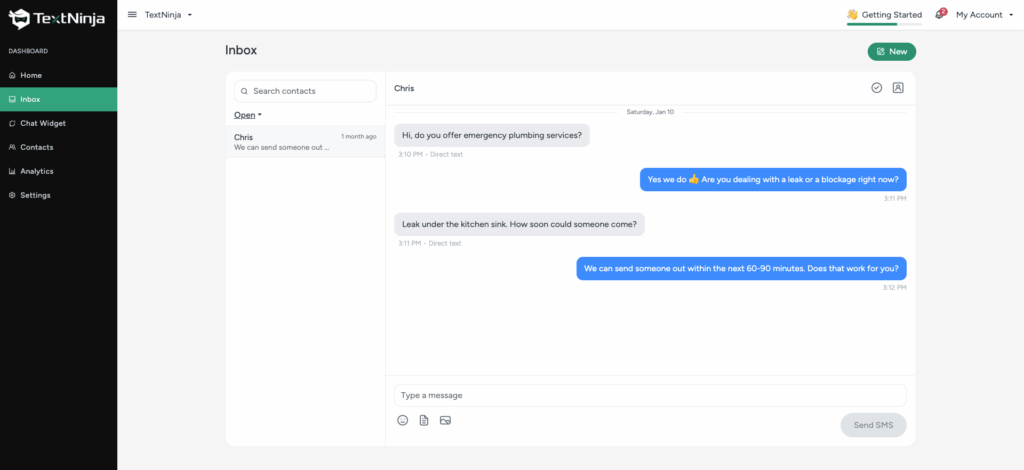
All inquiries land in a single inbox, and automated first replies make sure no lead waits for a response, even when your team's on a job.
Stop losing jobs to slow responses
TextNinja turns website visitors into text conversations so your team can respond faster and win more work.
Start free trial
7. Use specific calls to action
Most electrician websites default to generic CTAs like "Contact Us" or "Get in Touch." Those phrases ask the visitor to take a vague action without telling them what they'll actually get.
Specific CTAs perform noticeably better. "Get a Free Same-Day Estimate," "Book Your Panel Inspection," and "Request Emergency Service" tell the homeowner exactly what happens when they click.
The reduced ambiguity removes hesitation, especially for someone in a stressful situation. Place specific CTAs above the fold, repeat them through the page, and tailor the wording to match the service the page covers.
Blake George, owner of BMG Media Co, explains:
“The CTA wording matters more than most people think. We've seen electricians go from 'Contact Us' to something like 'Get a Free Same-Day Estimate' and watch their inquiry rate jump noticeably.
8. Get listed in trusted local directories
Beyond Google, there's a layer of local directories homeowners actually use to find trusted providers.
Chambers of Commerce, neighborhood association sites, and curated local business directories tend to show up for searches where people are specifically looking for vetted local providers.
Most of these listings cost a small annual fee, which is exactly why competitors skip them. Less saturation means the listings carry more weight when homeowners do find you there.
Aaron Traub, owner of Geaux SEO, shared his experience:
“One marketing tactic I've seen work really well for electricians is getting listed on trusted local sites like Chambers of Commerce and local business directories.
From a marketing standpoint, it puts your business in places where people already look for trusted local providers.
From an SEO standpoint, those listings create strong, location-based backlinks that help signal to Google that your business is established in your area.”
9. Show up at community events
Electrical and generator services are anxiety-driven purchases. People don't think about hiring an electrician until something's wrong, or they're worried something will go wrong soon.
That makes community events a powerful place to plant your name before the urgency hits.
Home shows, emergency preparedness expos, and neighborhood safety events put you in front of homeowners who are already thinking about protecting their homes.
Bringing something tangible, like a running standby generator powering a display, makes the conversation real in a way no brochure can.
When the storm rolls in or the breaker flips, you're the name they already trust.
Eric Osburn, owner of Osburn Services, says:
“One tactic that's consistently worked for us is showing up at local home shows and emergency preparedness expos in person, with equipment people can actually see and touch.”
What this means for electrical businesses
A clear pattern runs through every tip above. The electricians who consistently win work focus on showing up at the right moment, building trust quickly, and removing friction between the search and the booked job.
They make it obvious that hiring them is the easy choice.
Most homeowners follow a predictable decision pattern when something breaks. They search for a local provider, scan reviews and listings to gauge credibility, and contact the first one or two businesses that look reliable.
The electrician who shows up clearly in that search, responds quickly, and signals trust through reviews and specific service offerings usually wins the job.
You don't need to implement all the above tactics at once. Start with the area where your gap is biggest, whether that's local search visibility, response speed, or the way you handle existing customers after the job is done.
Then layer in additional systems over time.