
Running an HVAC business is one of those things that looks straightforward from the outside. You know the trade, you have the tools, and you've got customers who need you. What could be complicated about that?
Quite a lot, as it turns out.
Most HVAC operators who struggle aren't struggling because they're bad at doing the work. They're struggling because running a business requires an entirely different skill set than running a service call.
Scheduling, hiring, pricing, cash flow, customer communication, online reputation: none of that gets taught in any certification program. You learn it on the job, usually by making expensive mistakes.
This guide is for owner-operators who are somewhere in the middle of that learning curve. You've got a business that's working, at least most of the time, but you're aware of the gaps.
Jobs get missed. Scheduling falls apart in July. A good technician quits and takes months of institutional knowledge with them.
What follows is a practical look at the areas that make or break small HVAC businesses, from how you win customers in the first place to how you build something that doesn't depend entirely on you showing up every day.
We'll cover the operational realities of running a small team, what seasonal demand actually does to a business, and how to keep customers coming back once you've done good work for them.
There's no single secret to running a successful HVAC business. But there are a handful of things that consistently separate operators who build something sustainable from those who stay stuck working in the business instead of on it.
Winning customers
How homeowners choose an HVAC company
When a homeowner's air conditioning stops working on a 95-degree afternoon, they're not sitting down to do careful research. They're pulling out their phone, searching for someone local, and reaching out to the first two or three names that look credible.
The decision happens fast, and it's made on a pretty thin slice of available information.
Understanding that process matters because it changes how you think about marketing, reputation, and responsiveness.
According to research, 49% of homeowners start their search for a home service provider on Google, with only 21% starting by asking friends and family for recommendations.
That means your Google presence, specifically your reviews, your rating, and how complete your profile looks, is doing more work than any referral network you could build.
Reviews carry more weight than most operators realize. The data also shows that 74% of consumers have chosen a more expensive provider purely because they had better reviews.
Think about what that means in practice: you can be undercutting a competitor on price and still lose the job because they have a stronger online reputation.
A business with 80 reviews and a 4.6 rating will consistently win more inquiries than one with better pricing and a dozen reviews. Customers use review volume as a proxy for reliability, and a thin review profile makes even a good business look unproven.
Your website matters too, though not in the way most operators assume. Homeowners aren't reading your about page or studying your list of services.
They're checking that you look legitimate, that you serve their area, and that there's an easy way to get in touch.
A clean, simple site that loads quickly on a phone and makes it obvious how to reach you will outperform a polished but complicated one almost every time.
Speed is the last piece of this, and it's the one most operators underestimate.
When a homeowner reaches out to multiple HVAC companies, the first one to respond has a significant advantage.
Customers in an urgent situation are making decisions quickly. If you reply within a few minutes and a competitor replies two hours later, you've already won a large part of that battle regardless of what either of you quotes.
Where your best leads actually come from
Not all leads are created equal, and understanding where your best ones come from helps you spend your time and money in the right places.
Referrals
Referrals are still the highest-quality leads most HVAC businesses receive. A customer who was sent to you by a neighbor or a friend already trusts you before they've spoken to you.
They're less likely to shop around on price, more likely to book quickly, and more likely to become a long-term customer themselves.
The challenge with referrals is that you can't fully control them.
You can encourage them by doing great work, following up after jobs, and making it easy for happy customers to share your name, but you can't manufacture them on demand.
Google is where most new customers find you, particularly through local search and your Google Business Profile. When someone searches "HVAC repair near me," Google surfaces local businesses based on proximity, review volume, and profile completeness.
Keeping your profile up to date, responding to reviews, and making sure your service area is accurately listed are all things that directly affect whether you show up in those results.
This costs nothing but time and is one of the higher-leverage activities a small operator can invest in consistently.
Your website
Your website generates leads too, particularly if you've put any effort into search engine optimization.
Service pages, location-specific content, and even a basic blog can drive organic traffic from homeowners who are researching their options before they have an urgent problem.
These leads tend to be earlier in the decision process, but they often convert into maintenance agreement customers rather than one-time emergency calls, which makes them worth pursuing.
Paid advertising
Paid advertising and lead generation platforms can supplement your organic leads, but they tend to produce lower-quality inquiries at a higher cost per job.
They're worth knowing about, particularly during slow season when you want to keep volume up, but most small HVAC operators get a better return from investing in their Google presence and reputation than from buying leads.
Turning inquiries into booked jobs
Winning the inquiry is only half the battle. What happens in the minutes and hours after a customer reaches out often determines whether you actually get the job.
The core problem for most small HVAC teams is capacity. When you're running jobs all day, answering new inquiries falls to whoever has a free moment, which is often nobody.
Messages sit unanswered. Calls go to voicemail. By the time someone follows up, the customer has already booked with a competitor who responded faster.
Our research found that only 27% of HVAC businesses typically respond to new inquiries within 15 minutes, and more than two-thirds of HVAC owners say they've lost jobs because of missed calls or delayed replies.
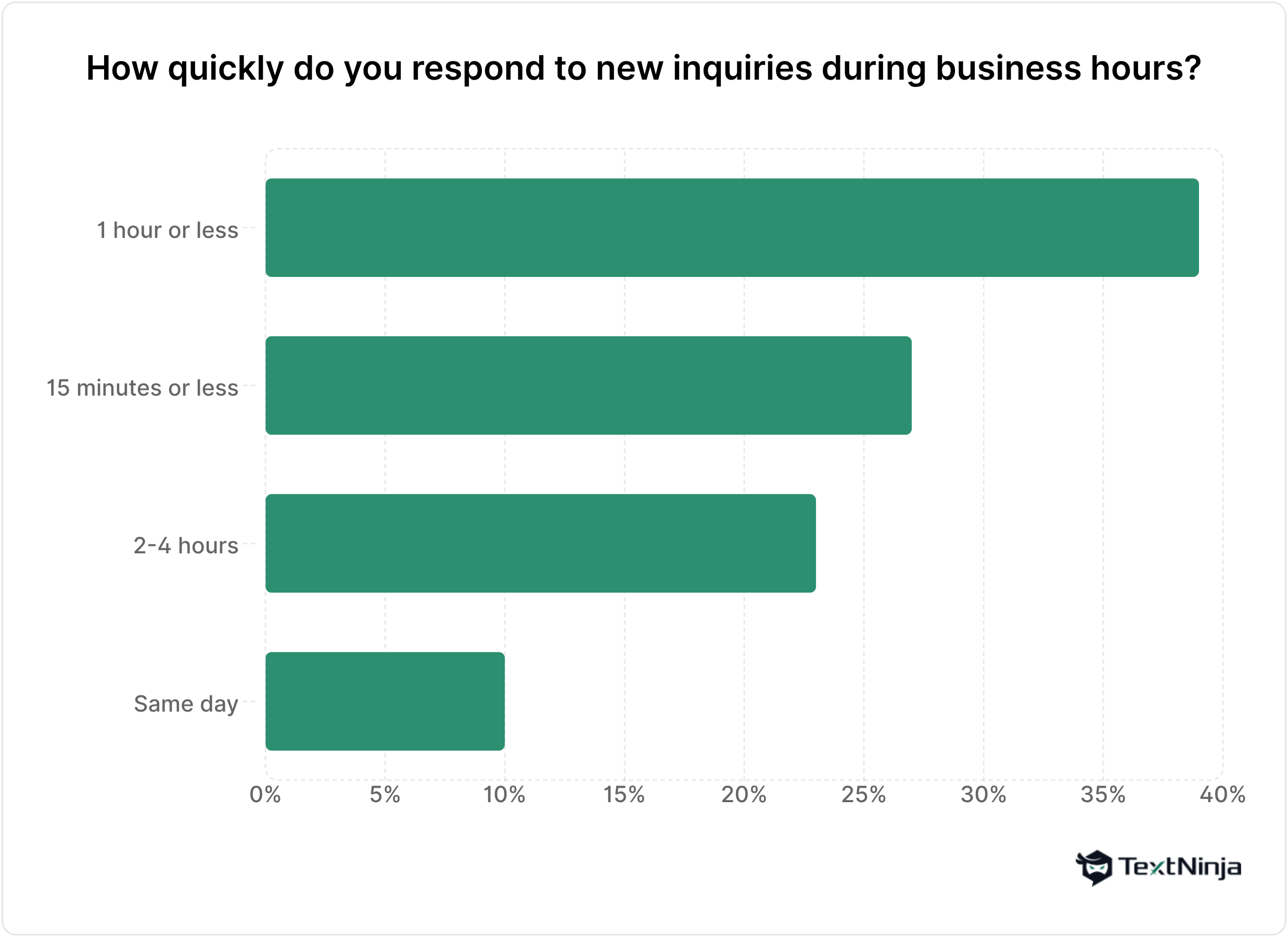
Those aren't isolated incidents. For most businesses, it's a recurring, expensive pattern.
The fix isn't necessarily hiring a full-time receptionist. It's building a process that makes sure every inquiry gets an acknowledgment quickly, even if a full response takes a little longer.
A customer who receives a message saying you've received their request and will be in touch shortly is far more likely to wait than one who hears nothing at all.
Some operators handle this with automated text responses that fire as soon as a new inquiry comes in through their website.
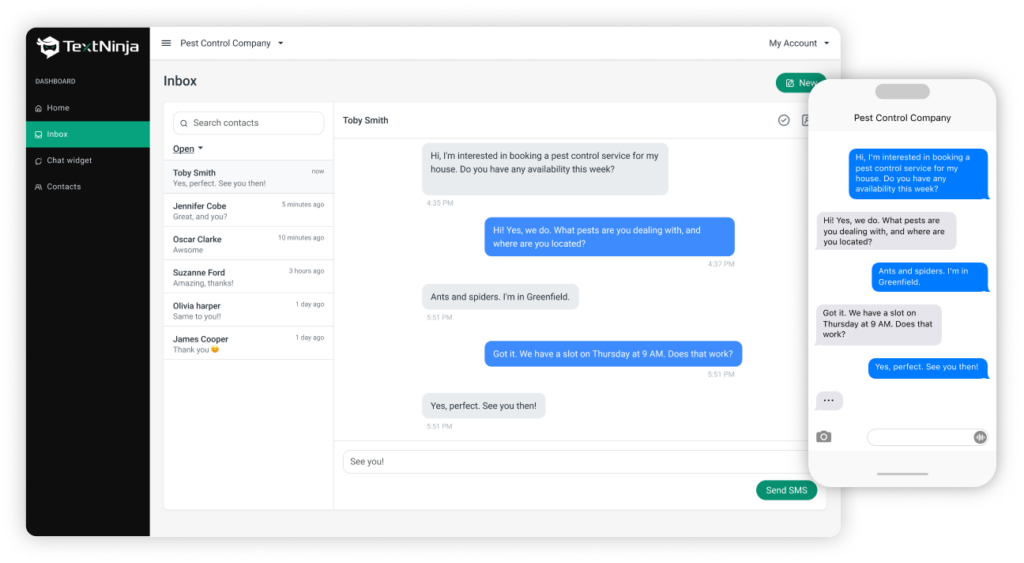
Tools like TextNinja are built specifically for this, letting customers reach out via text directly from your site and get an immediate response without anyone on your team having to stop what they're doing.
It keeps the conversation alive during the window when customers are most likely to book, and it moves everything into one place that's easy for a small team to manage.
Beyond speed, the quality of your follow-up matters. When you do connect with a customer, being clear about availability, process, and next steps builds confidence fast.
Stop losing jobs to slow responses
TextNinja turns website visitors into text conversations so your team can respond faster and win more work.
Start free trial
Customers who feel informed and taken care of from the first interaction are more likely to book, less likely to haggle on price, and more likely to leave a good review when the job is done.
One more thing worth addressing here: unbooked leads. Our research found that 42% of HVAC businesses either don't always follow up with unbooked leads or rely on informal, inconsistent follow-up processes.
If someone reached out, got a quote, and didn't book, they're still a warm lead. A single follow-up message a day or two later converts a meaningful percentage of those leads into jobs, at zero additional acquisition cost.
Pro tip: You can use TextNinja to set up an auto-responder message and ensure every lead gets an instant reply, even during off-hours. The software also enables your team to manage and respond to every lead from one centralized inbox.
Running the operation
Scheduling when every day is different
HVAC scheduling is genuinely hard. Jobs that should take two hours take four. A straightforward repair turns into a full system replacement. A customer calls at 8am with no heat and needs someone today.
Meanwhile you've already got a full book and two technicians running behind.
The operators who handle this best aren't the ones with the most sophisticated software. They're the ones who've accepted that the schedule will change every single day and built habits around managing that reality rather than fighting it.
Don't book your technicians to full capacity
Leaving a buffer in the day, even just one open slot per tech, gives you somewhere to absorb emergency calls and overruns without the whole schedule falling apart.
It feels counterintuitive when demand is high, but a fully packed schedule with no slack creates cascading delays that frustrate customers and exhaust your team.
Get better information before you book a job
A lot of scheduling problems start with incomplete intake. If a customer says "my AC isn't working" and you book a standard service call, but it turns out the entire system needs replacing, your tech is now tied up for four hours in a one-hour slot.
Asking a few more questions upfront, or having customers send a photo of the unit along with a description of the problem, gives you enough to make a more accurate time estimate before you commit.
Communicate proactively when things run late
Customers who know their technician is running behind are frustrated but understanding. Customers who sit waiting with no update for two hours and then get a call saying the tech is still an hour away are angry.
A quick text when you're running behind costs almost nothing and prevents a significant portion of the complaints and bad reviews that come from timing issues.
Managing a small team of technicians
The people-side of running an HVAC business is where a lot of operators feel least prepared. Most owner-operators came up through the trade, not through management, and managing people well is a skill that takes real time to develop.
Hiring for more than technical skill
A good field technician needs to be technically capable, but they also need to be reliable, presentable, and able to communicate with customers. That last part is consistently underweighted by operators hiring for the first time.
Your technicians are often the only face-to-face interaction a customer has with your business, and a tech who's skilled but dismissive or hard to talk to will cost you repeat business and reviews regardless of the quality of the work itself.
When you're hiring, don't limit your assessment to technical skills.
Do a scenario walkthrough. Ask the candidate how they'd handle a customer who's upset about a price, or how they'd explain a complicated repair to someone with no technical background.
The answers tell you a lot about whether this person can represent your business the way you need them to.
Keeping good technicians once you have them
Keeping good technicians is harder than finding them, particularly in markets where HVAC talent is in short supply.
Pay is part of it, but technicians also leave because they feel undervalued, don't see a path forward, or are working in a disorganized environment that makes their jobs harder than they need to be.
Clear expectations, regular feedback, and some investment in their ongoing training go a long way toward retention.
A technician who feels like they're growing is much less likely to take a call from a competitor.
Getting the autonomy balance right
You want your technicians to make decisions in the field without calling you about everything, but you also need some visibility into what's happening on jobs. The answer isn't a rigid rulebook for every scenario.
It's a shared understanding of where the lines are, built through regular communication and a willingness to debrief when something goes sideways rather than just moving on.
Dispatching without a dedicated dispatcher
In a larger HVAC operation, someone's entire job is dispatch. They know where every tech is, what's coming up, and how to slot in urgent calls without wrecking the day. In a small operation, that job falls to whoever's available, which is often the owner.
The challenge is that dispatch requires attention and continuity. You need to know the current status of every job, who's available, and what the next priority is.
When you're also running jobs yourself, handling sales calls, or dealing with a supplier problem, that continuity breaks down and things start slipping through.
A few habits make dispatch more manageable without a dedicated person:
- Require check-ins at the start and end of every job: Even just a quick text with their status gives you enough visibility to make good decisions about what comes next. It takes seconds and means you're never working from guesswork when something urgent comes in.
- Keep a running job list with estimated completion times: Update it as things change throughout the day so you're not relying on memory when a new urgent call arrives. This single habit eliminates most of the confusion that comes from trying to track multiple techs mentally.
- Establish a clear priority framework: Most operators prioritize no-heat and no-cooling calls over maintenance and non-urgent repairs, which is sensible. Making that explicit means your team knows the priority order without having to ask, and fewer decisions need to escalate to you.
- Recognize when you've hit the ceiling: One person can only track so many moving pieces before things start falling apart. If you're spending more than a couple of hours a day on dispatch coordination, a part-time admin will likely pay for themselves in recovered capacity and fewer dropped balls.
Handling seasonal demand
Surviving peak season
Peak season in HVAC is a test of everything at once. The phones ring constantly. Every tech is booked days out. Emergency calls come in faster than you can handle them.
Customers who've been waiting two days are getting impatient, and your team is running on fumes by the end of the second week.
The operators who get through peak season without too much damage are the ones who did their preparation in the spring, before the surge hit. That preparation has a few components:
- Sort out staffing early: If you know you'll need more capacity in July and August, the time to hire or arrange temporary help is April or May, not June. Seasonal technicians, part-time admin support, and subcontractor relationships all take time to set up properly, and trying to onboard someone new while simultaneously managing a full book of work rarely ends well.
- Get your inquiry handling ready for higher volume: During peak, the gap between a fast response and a slow one is even more costly than usual, because customers who can't get a quick answer will simply call the next name on their list. Make sure your website, your contact channels, and your response process can handle a significant increase in volume without breaking down.
- Be honest with customers about wait times: When you're booked out several days, telling customers that upfront and giving them a clear timeline is better than vague reassurances. Customers can accept a wait if they understand it, but being told someone will call them back and then hearing nothing for days erodes trust fast.
- Don't make significant operational changes mid-peak: Whatever's working well enough, keep it running. Save system changes and process improvements for when you have the time and headspace to implement them properly.
Stop losing jobs to slow responses
TextNinja turns website visitors into text conversations so your team can respond faster and win more work.
Start free trial
Making the most of slow season
The slow season is uncomfortable for most operators, mostly for cash flow reasons, but it's genuinely the best time to work on the business rather than just in it.
Do proactive customer outreach
Go through your job history from the past year or two and identify customers who are due for a system checkup, whose equipment is aging, or who expressed interest in a maintenance agreement and never signed one.
A personal outreach, even just a text or a brief call, reminding them that now is a good time to service their system before the next peak season, will convert a meaningful percentage into booked jobs without spending a dollar on marketing.
Invest in your team's development
When your technicians aren't running back-to-back calls, there's time to work on the things that get neglected during busy periods: new diagnostic techniques, customer communication skills, safety procedures, or certification upgrades.
Investing in your team's development during downtime makes them more capable and more loyal, and it tends to show up in customer feedback once the busy season starts again.
Audit your systems and fix what's broken
The scheduling process that causes friction every July, the intake form that produces incomplete information, the follow-up process that nobody actually follows: these are all things you know need attention but never get around to during peak.
Slow season is when you have the breathing room to actually fix them rather than just work around them.
Build your maintenance agreement base
Maintenance agreements are the most reliable tool for smoothing out the seasonal revenue curve.
A customer on a recurring maintenance plan represents predictable revenue during the months when the phone naturally slows down, and they're also your most likely source of urgent calls when something breaks unexpectedly.
Building your maintenance base during slow season, through targeted outreach and follow-up with past customers, makes the next slow season considerably less stressful.
Keeping customers for the long term
Communication throughout the job
Keeping customers is largely determined by what happens between the moment they book and the moment your technician drives away.
Most HVAC operators focus heavily on the quality of the technical work, which matters, but underestimate how much the communication experience shapes the customer's overall impression.
A technically flawless job can still generate a lukewarm review if the customer felt uninformed, ignored, or surprised at any point along the way.
And a job that hits a minor snag can generate a glowing review if the customer feels kept in the loop and well taken care of throughout.
The basics aren't complicated:
- Confirm the appointment after booking: Send a message that includes the date, time window, and what to expect. Follow that up with a reminder the day before and a heads-up when the technician is on their way, ideally with a name and a rough arrival time.
- Tell customers about problems before they have to ask: A job that's going to run longer than expected, a part that needs to be ordered, a return visit that's required: customers can handle all of these things if they hear about them promptly and clearly. What they struggle to handle is finding out at the last minute, or not at all until they follow up themselves.
- Follow up after the job: A text checking that everything's working as expected, sent a day or two after the visit, shows customers that your interest in their experience doesn't end when the invoice is paid. It also gives you the opportunity to catch any issues early, before they turn into a complaint or a negative review.
Building a customer base that comes back
A one-time customer is valuable. A customer who calls you every time they have an HVAC problem, refers their neighbors to you, and signs up for a maintenance agreement is worth many times more over the course of a relationship.
Building that kind of customer base doesn't happen by accident.
The foundation is straightforward: do good work, communicate well, and make the experience easy. Customers who feel genuinely taken care of come back without needing much prompting.
But even satisfied customers are busy and forgetful, and most of them won't think to call you again until something breaks, unless you give them a reason to stay in touch.
Maintenance agreements are the most effective tool most HVAC operators underuse.
A well-structured agreement, typically covering one or two system checkups per year at a predictable price, gives customers a reason to stay connected with your business through the quieter months.
It gives you predictable recurring revenue and first right of refusal when something in the system eventually needs replacing.
And customers on maintenance agreements tend to be significantly more loyal than one-time service customers, because they've made an ongoing commitment rather than a single transaction.
The pitch for a maintenance agreement is most effective right after a successful service call, when the customer's confidence in you is highest.
Train your technicians to bring it up naturally at the end of a job rather than leaving it to a follow-up call that may or may not happen.
A simple explanation of what's included and what it costs, delivered by a technician the customer has just watched solve their problem competently, converts at a much higher rate than any marketing email.
Beyond maintenance agreements, staying in touch with past customers on a light-touch basis helps keep your business front of mind.
A seasonal reminder about system checkups, a note about a rebate program, or even a brief check-in before peak season are all ways to reconnect without being intrusive.
Customers who hear from you once or twice a year in a helpful context are far more likely to think of you first when something goes wrong.
Managing your online reputation
Your online reputation is part of your sales process whether you manage it actively or not.
Customers are checking your reviews before they ever contact you, and what they find shapes their decision about whether to reach out at all.
The numbers here are worth understanding. According to LocalImpact research, 92% of consumers read online reviews before choosing a business, and more than 78% won't even consider a provider with a rating below 4 stars.
A quarter of consumers set the bar even higher, requiring at least 4.5 stars before they'll make contact.
In a market where customers are reaching out to several providers at once, a weak review profile means you're being filtered out before the competition even begins.
Google is where most of this happens. Data from the same LocalImpact report shows that 86% of consumers use Google to look up reviews of businesses, making your Google Business Profile the single most important piece of online real estate you have.
Yelp and Facebook matter too, but Google is where the majority of your potential customers will form their first impression of your business.
Getting reviews consistently
Getting reviews consistently requires a process, not just goodwill. Most customers who've had a genuinely positive experience are willing to leave a review, but they don't think to do it unless someone asks.
The most effective ask happens in the moment, right after the job is done and the customer is satisfied.
Train your technicians to make a brief, natural ask before they leave: something along the lines of letting the customer know that reviews make a real difference for a small business, and that they'd appreciate it if the customer had a minute to share their experience on Google.
Follow that up with a text containing a direct link to your review page and you'll see a meaningful increase in review volume without any additional effort.
Pro tip: You can use LocalImpact to set up automated email and SMS review request campaigns, ensuring every customer gets asked to leave a review.
Replying to reviews
Negative reviews are unavoidable in any service business. What matters is how you respond to them. Research shows that 78% of consumers say a thoughtful response to a negative review made them more likely to trust a business.
Potential customers aren't just reading the complaints; they're reading how you handle them.
A calm, professional response that acknowledges the issue and offers to make it right signals reliability and accountability, and often does more for your reputation than a string of five-star reviews.
Keeping up with reviews across multiple platforms can quickly become time-consuming, particularly if you're monitoring Google, Yelp, and Facebook separately.
Tools like LocalImpact consolidate your reviews from across platforms into one place, notify you when new reviews come in, and make it easier to respond promptly without having to check multiple dashboards throughout the day.
For a small operator managing reviews on top of everything else, that kind of streamlined visibility makes a real difference in how consistently you're able to stay on top of it.
Showcasing reviews
Your reviews shouldn't just sit on Google waiting to be found.
Pulling them into your website, whether through a dedicated testimonials section or an embedded review widget, means that customers who land on your site see social proof immediately without having to go looking for it.
A steady stream of recent, positive reviews displayed prominently on your homepage or service pages builds confidence at exactly the moment a potential customer is deciding whether to reach out.
It's also worth noting that as AI-powered search tools become a bigger part of how consumers research businesses, your review presence matters in a new way.
Our research found that even when AI recommends a business, 46% of consumers will read reviews more carefully before committing.
A strong, well-managed review profile isn't just a trust signal for customers browsing Google. It's increasingly a factor in whether AI tools surface your business favorably at all.
Stop losing jobs to slow responses
TextNinja turns website visitors into text conversations so your team can respond faster and win more work.
Start free trial
The business behind the business
Pricing for profit, not just to win the job
Pricing is one of the areas where small HVAC operators most commonly leave money on the table, usually without realizing it.
The instinct to price competitively is understandable, but competitive pricing based on a rough sense of what the market charges, rather than a clear understanding of your own costs, is a reliable path to staying busy without actually building financial stability.
Know your true cost per job
The starting point is knowing your true cost per job. That means going beyond parts and labor to account for overhead: vehicle costs, insurance, tools, software subscriptions, the time you spend on scheduling and admin, and your own salary if you're paying yourself one.
When operators add up all of these costs honestly and divide them across their actual billable hours, they often find their margins are considerably thinner than they assumed.
Once you know your costs, you can price with confidence rather than anxiety.
Handling price shoppers
Price shoppers are a reality in HVAC, particularly for non-urgent work.
The most effective way to handle them is to clearly articulate what they're getting for the price: your response time, your warranty, your track record, and the confidence that comes from working with a business that has the reviews and reputation to back up what it charges.
Many customers who initially lead with price end up choosing the provider who gave them the most confidence, particularly when the job is a significant one.
Raising your prices
Raising prices is something many operators avoid for longer than they should, usually out of worry that existing customers will leave.
In practice, modest and well-communicated price increases rarely cause customer attrition, particularly for businesses with strong relationships and good reputations.
Customers who value your work expect that costs go up over time. As long as the value is clear, your prices can reflect what the work is actually worth.
Managing cash flow through seasonal swings
HVAC businesses can generate strong annual revenue and still run into serious cash problems.
The seasonal nature of demand means that money comes in heavily during a few peak months and slows to a trickle during others, but your fixed costs, vehicle payments, insurance premiums, staff wages, don't follow the same pattern.
Managing that mismatch is one of the more underrated skills in running a successful HVAC operation:
- Build a cash reserve during peak season: When the money is coming in fast, it's tempting to invest in new equipment, hire additional staff, or upgrade systems. Some of those investments make sense, but making them without leaving a sufficient buffer for the slow months is a pattern that leaves operators financially stressed every winter.
- Use maintenance agreements to smooth out revenue: A customer base that pays monthly or annually for maintenance coverage generates revenue during the months when emergency call volume drops, smoothing out the revenue curve without requiring you to find entirely new customers. This makes maintenance agreements valuable not just as a retention tool but as a cash flow management tool.
- Tighten up your invoicing routine: Getting paid quickly means sending invoices immediately after jobs are completed rather than in batches at the end of the week, and following up promptly on anything overdue. Many small operators are sitting on several weeks' worth of earned revenue in unpaid invoices simply because they haven't built a consistent invoicing routine.
- Establish a line of credit before you need it: If you find yourself in a cash crunch during slow season, a business line of credit is a far better solution than deferring supplier payments or letting payroll get tight. Setting one up during a period when your business is performing well means it's available on reasonable terms when you actually need to draw on it.
Building systems so the business doesn't depend on you
Most small HVAC businesses are built around the owner. You make the calls, solve the problems, know every customer, and hold the operation together through sheer effort and presence.
That works up to a point, but it also means the business has a hard ceiling: it can only grow as far as your personal capacity allows, and it's fragile in a way that a well-systemized business isn't.
Document your processes
Building systems doesn't mean turning your business into a corporate machine. It means writing down how things get done so that other people can do them consistently without needing to ask you every time.
Start with the processes that cause the most friction or that you find yourself explaining repeatedly: how to handle a new inquiry, how to schedule a return visit, how to follow up with a customer after a job, how to handle a complaint.
When those processes exist in writing, they can be handed off, improved, and followed consistently even when you're not in the room.
Start delegating
Delegation is uncomfortable for most owner-operators, particularly early on. You've built the business and you know how you want things done.
Handing off responsibility means accepting that things will occasionally be done differently than you'd have done them yourself, and that some mistakes will happen.
The alternative, though, is staying personally involved in every decision indefinitely, which caps what the business can become and keeps you tied to daily operations long after you'd prefer to step back.
The practical approach is to delegate one thing at a time, starting with tasks that are well-defined and relatively low-risk.
Scheduling coordination, customer follow-up, invoice management: these are all areas where a capable admin or office manager can take ownership once they have clear guidelines to work from. Each thing you successfully hand off creates capacity for you to focus on the parts of the business that genuinely need your attention.
Hire for the business you want, not the one you have today
If you know you want to be running a five-truck operation in three years, the systems, processes, and people you need for that business are different from what you need today.
Building toward that structure incrementally, rather than waiting until you're already overwhelmed, is what makes the growth manageable when it comes.
What it actually takes to build an HVAC business that lasts
The operators who build something lasting in this industry tend to share a few things in common. They're technically excellent, but so are a lot of operators who never quite get ahead.
What separates them is how they run the business side: consistently, deliberately, and with an eye on the parts that are easy to neglect when you're busy.
- Win customers with reputation and responsiveness: Customers are choosing before they ever speak to you, based on what they find online and how quickly you respond when they reach out. Getting those two things right doesn't require a big marketing budget. It requires a strong review profile and a process that ensures no inquiry goes unanswered for longer than a few minutes.
- Run your team with clear fundamentals: Hire people who can represent your business, give them clear expectations, build scheduling habits that absorb disruption rather than collapse under it, and make sure inquiry handling doesn't fall apart the moment everyone's busy.
- Treat slow season as an investment period: The operators who navigate peaks and valleys well are the ones who use the quiet periods to build their customer base, their systems, their financial buffer, and their team's capabilities.
- Gradually reduce the business's dependence on you: The businesses that genuinely last are the ones that stop depending entirely on the owner. That transition doesn't happen overnight, but it starts with small decisions: writing down a process, handing off a task, building a system that works without you having to personally hold it together.
None of this is beyond reach for a small operator with a clear head and the willingness to work on the business as well as in it.
The gap between where most HVAC businesses are and where they could be isn't usually talent or effort. It's the handful of operational habits and business fundamentals covered in this guide, applied consistently over time.