Most owners would tell you their team is good with customers. The phone gets answered, messages get returned, and quotes go out on time. From the inside, everything looks like it's working.
And yet the booking numbers feel lighter than they should. Marketing spend is up, the schedule has gaps that shouldn't be there, and something isn't adding up, even though nothing obvious seems broken either.
Here's what's usually going on:
The team is handling the leads they can see, while the leads that get dropped are the ones nobody ever hears about again.That means nobody remembers them, which means nothing ever gets flagged.
What a dropped lead actually looks like
When owners think about dropped leads, they usually picture something dramatic, like an inquiry that got completely ignored, a message nobody ever opened, or a customer who called three times and gave up.
In reality, most dropped leads don't look like that at all. A dropped lead is any inquiry that didn't get a fast, clear, human response while the customer was still deciding.
A reply that goes out two hours after someone submitted a contact form is a dropped lead if the customer already booked a competitor by lunchtime. A voicemail returned the next morning is a dropped lead if the customer hired someone that afternoon.
The customer wasn't upset and didn't complain. They just moved on, and the business never found out why.
Why the problem stays invisible
The reason this keeps happening is that the feedback loop is broken. Customers who didn't hear back in time don't call to explain themselves, and they don't leave reviews about it either. They just hire someone else and get on with their day.
What makes this worse is that customers are almost always talking to your competitors at the same time. A LocalImpact survey found that 85% of consumers reach out to 2-4 providers before making a decision.
So a two-hour delay on your end isn't two hours of the customer sitting patiently by the phone. It's two hours of other businesses responding, quoting, and closing the job.
The team, meanwhile, naturally reports on the work they did. They talk about the jobs they quoted, the conversations they had, and the customers they won.
They're not hiding anything. They just have no way to report on the inquiries that quietly slipped past during a busy afternoon, because from their perspective, those inquiries are invisible too.
A few specific patterns make this worse:
- Inquiries arrive through channels nobody's actively watching: Contact forms, Facebook messages, Google Business Profile messages, and after-hours voicemails all land somewhere, but nobody's job is to check that somewhere every 15 minutes.
- Ownership gets assumed rather than assigned: When a message comes in and three people can see it, everyone quietly figures somebody else has got it.
- The team is most responsive during slow hours: That would be fine, except the highest-intent leads usually come in during the busy hours, when everyone's heads-down.
- Follow-up depends on memory: And memory is the first thing that breaks when a team is running between jobs, fielding calls, and trying to close out the day.
None of these patterns look like mistakes in the moment. They look like a busy team doing its best, and the damage only shows up in aggregate, which is exactly what nobody's measuring.
What changes when you can actually see it
The businesses that have fixed this problem did it by changing the channel where the first customer interaction happens.
That's the part most owners miss. The reason inquiries slip through comes down to the channels themselves.
Contact forms, voicemails, Facebook messages, and email all share the same weakness, which is that they sit quietly in some inbox or queue until somebody goes looking.
Nothing about them demands a response in the moment, so they get handled whenever the team has a gap, which is usually hours later.
The fix is to route the first customer interaction into a channel where speed is already the default.
For most home service teams, that channel is SMS.
Texts get read within minutes, they land on the phones people already carry everywhere, and they create a natural back-and-forth that matches how customers actually want to communicate when they have a problem that needs solving.
Stop losing jobs to slow responses
TextNinja turns website visitors into text conversations so your team can respond faster and win more work.
Start free trial
It changes the physics of the interaction. A text arrives on someone's phone and gets read almost immediately.
There's no separate inbox to check, no queue to monitor, and no app to remember to open. The phone buzzes, someone reads it, and a reply goes out in the next few minutes.
That shift changes what's possible operationally. The first customer interaction becomes something that happens naturally, the same way any other text conversation happens.
Busy hours stop being the hours when money leaks out, because replying to a text between jobs takes 20 seconds and doesn't pull anyone back to a desk.
Owners who make this switch usually describe the same thing. They stop wondering where their leads are going, they stop second-guessing their marketing, and they start having conversations with customers who would've quietly disappeared six months earlier.
How TextNinja can help
TextNinja puts a text widget on your website so high-intent visitors can start a conversation the moment they're ready, in the channel your team already responds to fastest.
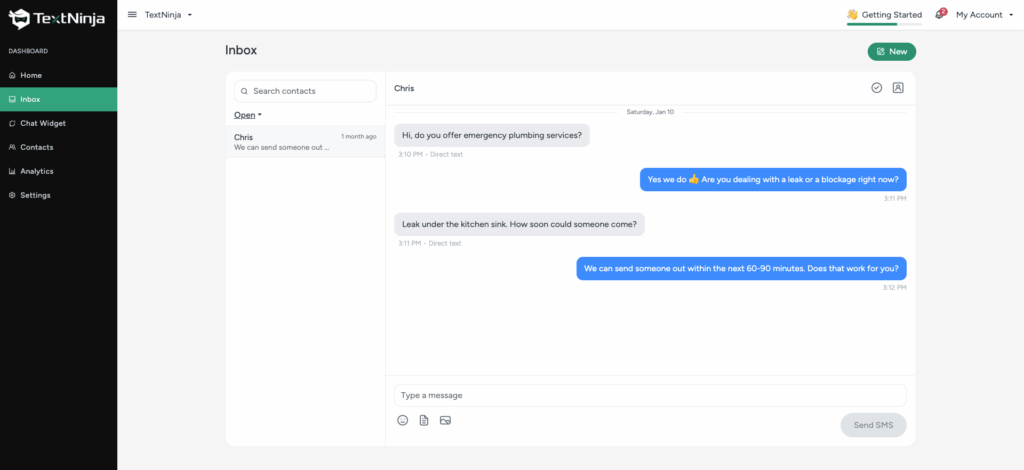
Those conversations land as text messages on your team's phones, so replies go out in minutes.
An autoresponder sends an immediate acknowledgement when the team is mid-job, so customers know they've reached a real business and aren't left wondering.
And a shared inbox keeps every conversation in one place, with clear ownership, so nothing gets scattered across personal phones, voicemail boxes, and email threads.