Growing a home service business comes down to a handful of moves that consistently bring in calls and keep customers coming back.
We asked owners, operators, and marketers who work with home service businesses to share the tactics that have actually worked for them.
What follows is a practical list you can start putting to use this week, with real examples and results from people running the work day to day.
1. Fix your website and listings before spending on ads
Before you put a dollar into Google Ads or postcards, make sure the basics actually work.
A surprising number of home service websites have a setting that blocks Google from indexing them, a contact form that doesn’t work, or a phone number that's wrong on half the directories out there.
Open your site on your phone, submit your own form, and call your own number to confirm every one can reach you. Check that your Google Business Profile is complete and that your social links go somewhere live.
Home service customers are high-intent searchers ready to call, so a broken foundation sends that call straight to a competitor. Michael Zarlingo of Animas Excavating saw this firsthand after years of strong word-of-mouth that never showed up online.
"Once the infrastructure issues were identified and addressed, the path to organic visibility opened up for the first time.
The business had been operating for seven years with strong fundamentals and a 5.0 Google rating, just invisible to the people actively searching for exactly what it offers."
2. Build landing pages around specific problems
When someone's heat goes out at night or a pipe bursts on a Saturday, they search for that exact problem in their own words. Build a dedicated page for each high-intent situation you handle, written in plain language with a phone number above the fold.
Pages like "emergency AC repair," "water heater not heating," or "roof leak repair" tend to convert far better than one broad services page. Match the wording to what people actually type, and your click-through and call rates both climb.
It also helps to line up your Google Business Profile categories with these pages so your local rankings stay consistent. Jeff Pratt of JPG Designs has watched this play out across HVAC, plumbing, and landscaping clients.
"The reason it works for home services specifically is urgency. A homeowner searching at 11pm isn't browsing, they're deciding. If your page mirrors exactly what they typed, you win the click and usually the call."
3. Create a separate page for each area you serve
Once you've nailed problem-specific pages, do the same for geography. A single "service areas" page listing 30 towns reads as thin content and tends to rank for nothing.
Give each neighborhood or suburb its own URL with genuinely local proof on it:
- Before and after photos from jobs in that specific area, with the street or community named
- A couple of embedded reviews from customers nearby
- Response times and rough pricing for that location
The real unlock comes when you link each area page to the matching technician or location on your Google Business Profile, which lifts map-pack visibility across the whole account.
Keep these pages real and useful, since spun-up thin pages get filtered out fast.
Sarah Trujillo of Wagner Mechanical uses this approach for her HVAC service area around Albuquerque.
"For example, instead of relying on a single 'HVAC Company Albuquerque' page, we create dedicated pages for areas like Rio Rancho, Los Lunas, Corrales, and other nearby communities, each tailored to the services, search intent, and language relevant to that area."
4. Optimize your Google Business Profile for conversions
Your Google Business Profile often does more selling than your website, especially for urgent searches. Treat it like a live page rather than a set-and-forget listing.
A few things that move the needle:
- Post weekly with real job photos and the neighborhood named in the caption
- Seed the Q&A section with the pricing, availability, and warranty questions customers actually ask
- Set your primary category to match your most common service, since the wrong category can suppress visibility
- Add a dedicated call-tracking number to the profile so you can see exactly how many calls it drives.
Justin Vorhees of IgniteLocal builds growth frameworks for local service businesses and stresses getting your categories right.
"Optimize your Google Business Profile by selecting the fewest, most specific categories possible rather than a broad list.
This narrow focus improves your ranking relevance for high-intent searches and ensures you're reaching the right customers in your specific service area."
5. Make online reviews part of every job
Reviews are the backbone of your local reputation, and the businesses that grow treat collecting them as part of finishing the job.
Set up an automatic text or email that goes out after each completed visit with a direct link to your review page. Timing matters even more than the wording, so send the request when the customer is feeling the value most.
You can sharpen results by segmenting the ask:
- Emergency calls get the request a few hours later, while the relief is fresh
- Bigger installs go out a day or two later, after the customer has used the work
- Recurring clients make better targets than first-timers who haven't formed an opinion yet
Reviews with photos tend to rank higher and build more trust, so prompt for a quick picture too. Rhillane Ayoub of Rhillane Marketing rebuilt this flow for a Texas plumbing client and tracked the difference.
"The non-obvious piece: timing the ask to the moment the customer actually feels the value (4 hours after an emergency fix, 48 hours after a water heater install) matters more than the email copy itself."
6. Respond to every call and lead quickly
Speed is one of the biggest levers in home services, because customers in a panic usually book with whoever answers first. Track how many calls you're missing during busy hours and after the workday ends, then close those gaps.
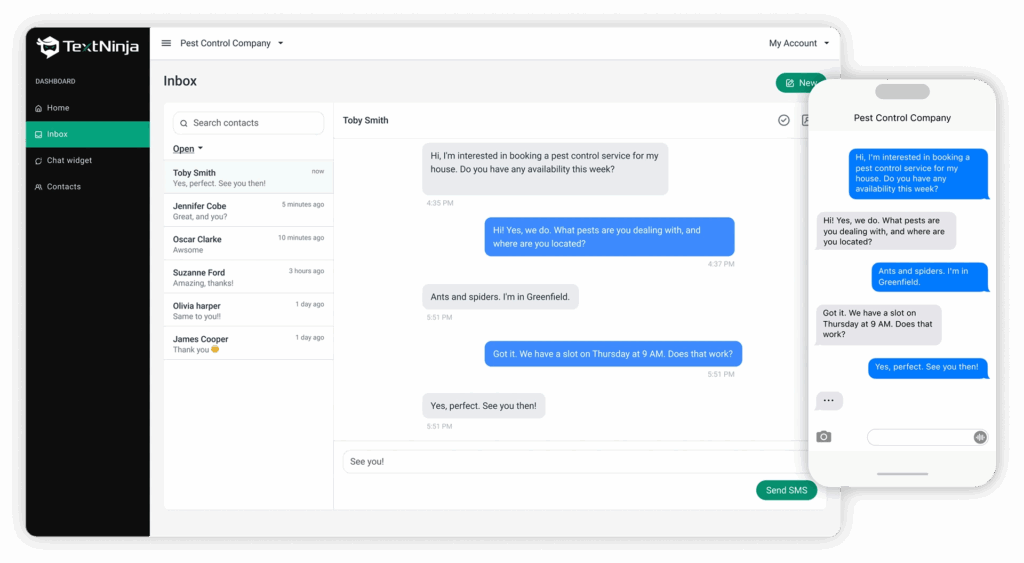
A missed-call text-back is the simplest fix: when a call goes unanswered, an automatic message asks if they need urgent help today. Pair that with a goal of answering or returning every lead within a few minutes.
Capturing the calls you've already paid to generate is often cheaper than buying new ones. Bowen He of Webzilla Digital Marketing has seen this work across plumbing, HVAC, and electrical clients.
“A tactic that delivered strong results was implementing missed-call text-back automation. Many home service businesses lose leads simply because technicians are on-site and cannot answer calls immediately.
We set up automated SMS follow-ups for missed calls with messages like, "Sorry we missed your call — are you needing urgent service today?"
This performed extremely well for plumbing, HVAC, and electrical businesses because customers often contact multiple providers at once and usually book with whoever responds first.”
Pro tip: You can use TextNinja to set up an auto-responder text message that gets sent to leads who inquire about your services. And add an SMS widget to your website to let visitors reach you via text.
7. Document every job with photos
Every completed job is a marketing asset if you capture it before the crew leaves. Take before and after photos, note the city and the type of work, and record why the customer chose you.
Those images become website project pages, Google Business Profile posts, and powerful follow-ups on future quotes. Homeowners want proof you've solved their exact problem at a home like theirs, and real photos answer that better than any stock image.
Build the habit on every job, even the simple ones, and the library compounds over time.
Steve Rice of Lawn Kings treats each install this way:
"My advice is to document every job like it is a case study, even if it is simple.
Over time, those real examples become stronger than ads because they answer the customer's biggest question: 'Can you do this for a home like mine?'"
Stop losing jobs to slow responses
TextNinja turns website visitors into text conversations so your team can respond faster and win more work.
Start free trial
8. Show customers the work they can't see
Plenty of home service work happens in attics, crawlspaces, and behind walls where the customer never sees it. That gap is where distrust creeps in, so close it with quick photos and short videos of what you found and what you fixed.
Text a clip showing the rusted coil, the failing motor, or the flashing before the new materials go on. Seeing the actual problem helps people make confident decisions without feeling pressured into a sale.
This transparency tends to win the bigger jobs, since customers trust what they can see with their own eyes. David Cochran of Cochran Heating and Air built his diagnostics around this idea:
"Most homeowners cannot see their equipment in attics or crawlspaces, which often creates a barrier of distrust.
Seeing a rusted coil or a failing motor on their phone helps them make informed decisions about their comfort without feeling pressured."
9. Offer financing or skip the upfront deposit
Money is the most common reason a homeowner stalls on a big job, so make the financial side easier. Offering installment financing on high-ticket work like repipes, replacements, and upgrades keeps sticker shock from killing the deal.
Some operators go further and take a deposit off the table entirely, collecting payment only once the work is done and the customer is happy. That move removes the homeowner's biggest fear, which is a contractor vanishing with their money.
It also holds your crew to a high standard, since the job has to be right to get paid.
John Martin of Martin & Sons built his reputation on this policy:
"We require no money down to start a job, and customers only pay once the project is 100% complete and they are 100% satisfied."
10. Build your brand around one thing you do differently
Most home service companies compete on quality and speed, which customers already expect. Pick one real frustration in your industry and build your whole brand around solving it.
That could be upfront pricing in a trade that usually hides it, a guarantee nobody else offers, or a specialty that's hard to find locally.
When your name is tied to fixing a specific pain point, customers remember you a year later and refer you for that exact reason.
Carry the theme through your website, your scripts, and the way your techs talk on site.
Tim Alagushov of IRBIS HVAC made transparency the foundation of everything they do.
"When we launched IRBIS in 2019, the standard practice in HVAC was to hide pricing until a tech was already in the customer's home.
We did the opposite: published prices on the website from day one and built an online calculator for both installations and repairs."
11. Use a referral offer customers can pass along
Referrals turn your happiest customers into a steady lead source, though asking for one feels awkward to most people. The fix is to put a ready-made offer in their hands so the introduction takes no effort.
After a job, leave a small credit your customer can hand to a neighbor or friend, ideally something physical with a short, warm note. Framing it as a gift the customer gives lets the referrer look generous, which keeps word-of-mouth feeling natural.
A neighbor who's already seen your van and heard about the work is one of the cheapest leads you'll find. Marcos De Andrade of Green Planet Cleaning built a simple two-envelope system around this.
“After every recurring clean in luxury neighborhoods like Pacific Heights, Noe Valley, or Atherton, our team leaves two envelopes with the client.
The first is a hand-written thank-you note from the cleaner who serviced the home.
The second is sealed and addressed "To my neighbor," containing a small first-clean credit and a one-line note: "Marcos from Green Planet asked me to give this to one neighbor I trust."
The client decides which neighbor to hand it to.”
12. Sell maintenance plans as an ongoing service
Maintenance plans give you predictable, recurring revenue and a reason to stay in the customer's home year-round. Build a simple plan with priority scheduling, seasonal checkups, and small perks like filter changes, then price it so the value is obvious.
Train your techs to explain it during tune-ups and repairs, when the customer can already see the benefit of staying ahead of problems. The real payoff is that you're the company already on file when something breaks, which usually wins you the repair and the replacement too.
Position the plan around convenience and catching issues early so it feels like a service worth keeping. Dustin Caison of Southern Air runs his Comfort Club exactly this way.
"We use our Comfort Club to lock in recurring touchpoints, priority service, filter changes, and annual checkups so we're in the home before the emergency call happens."
13. Follow up after the job with a check-in
After the invoice is paid, most home service businesses go quiet, which leaves easy retention and referrals on the table. A short follow-up a few weeks later keeps you top of mind and often surfaces small issues before they turn into complaints.
Make the message feel like genuine care by asking a simple operational question, like whether everything's still working since the visit. That kind of touch tends to bring both repeat bookings and, when you do ask, better reviews.
Saulo Canny of Canny Electrics keeps his check-in deliberately low-key.
"One underused growth tactic is scheduling a 30 day follow up message that asks a single operational question rather than requesting a review. For example, is everything still working as expected since the visit."
Putting it to work
These tips share a common thread: speed, proof, and trust win home service customers more reliably than a bigger ad budget. Pick two or three that fit where your business is right now, put them in place this month, and build from there.
While you’re here, check out our latest report on how home services businesses approach marketing.