While most home service businesses believe they’re competing on price or reputation, the truth is that they’re competing on response speed.
Most homeowners aren’t comparing providers. Instead, they’re likely just waiting for someone to finally respond.
What actually happens when a homeowner reaches out
When there’s a pipe leak or the AC stops working, homeowners aren’t in research mode. What they want is for someone to fix their problem quickly.
They’ll usually head to Google, pick a few options that seem credible, and then reach out.
Most often, they’ll contact multiple businesses at the same time. Why?
Because they don’t know who’s going to respond (and when).
In most cases, the business that responds first is the one that gets the job.
Why being slow to respond costs you the job
From an operator’s perspective, a delayed response seems understandable. Their team is busy. The message will be handled soon.
But from the homeowner’s perspective, silence might seem very irresponsible, especially if they have an emergency.
It’s also very stressful. They don’t know if anyone read their message or when (or if) they’ll hear back. They might be wondering whether to keep waiting or look for someone else.
And in most cases, if you don’t respond in a few hours, they’ll move on.
So while you’re thinking that someone else got the job because they were cheaper, it’s likely that they were just faster to respond.
Why “more leads” doesn’t solve the problem
When you lose out on jobs, your gut reaction might be that you just need to generate more leads.
Either by spending more on ads, working on your SEO, or doing something else.
But generating more leads while still being slow or inconsistent in your responses won’t solve the problem. You’ll just get more opportunities that will fizzle out, wasting your marketing budget in the process.
Most home service businesses are still set up in a way that doesn’t align with the way today’s consumers buy services.
They have inquiries coming in through contact forms, email, voicemail, and other channels. It isn’t always clear who owns what. And follow-ups are usually inconsistent.
On top of that, they might take 12-24 hours to respond to a lead. But that’s way too slow since most consumers expect businesses to respond in a few hours.
When it comes to emergencies specifically, fast response time is what consumers value the most.
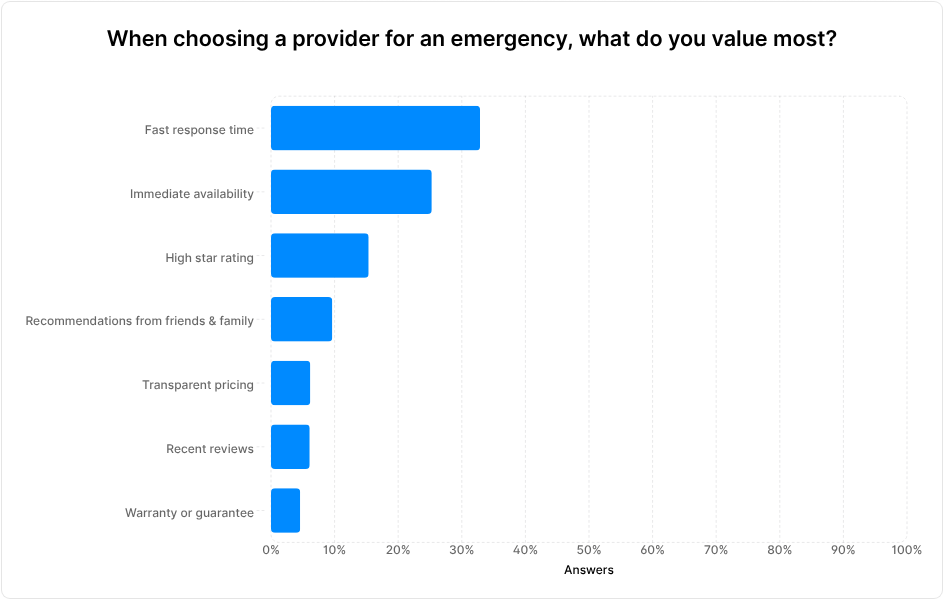
With most businesses taking quite a bit of time to respond to inquiries, it’s not hard to see why jobs fall through the cracks.
And if this sounds like you, it’s likely that you don’t need more leads. You just need to find a way to manage your existing leads more effectively.
A better way to handle customer inquiries
TextNinja is a web-to-text platform that allows home service businesses to collect customer inquiries via a text widget added to their website.
New inquiries arrive directly to your smartphone where you can start a text conversation with the lead immediately.
Ready to grow your business?
Capture leads, engage customers instantly, and turn conversations into sales with TextNinja's powerful SMS chat widget.
Start free trial
There’s also the option to set up automated responses to ensure every lead gets a reply even when you’re busy.
And a shared inbox that helps your team stay on top of every lead and makes sure no inquiry gets ignored.
Start responding to new leads instantly and see what that does to your business’s bottom line. Try it out with a free 14-day trial today.